describe yourself as 3 fictional characters, tagged by @lucreceborgia – thanks!

probably fleabag:

lorelai gilmore (i am That Bitch when it comes to pop culture references/knowledge):

and kelly kapoor (i have her taste in fashion, makeup, and entertainment, i just can’t afford it– also her tendency towards hyperbole, her tendency to be dramatic, and internet addiction):

thanks! tagging anyone that wants to do this šŸ’–šŸ™Œ

eerian-sadow:

dynamicsymmetry:

Good stuff.

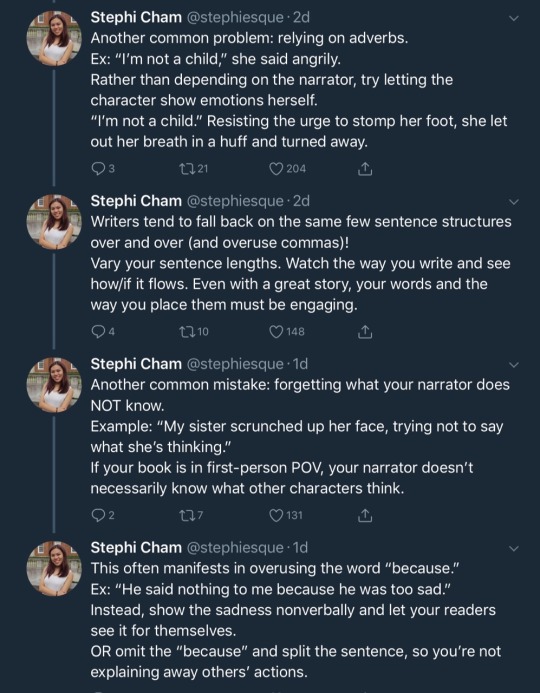
This. This is good fiction writing advice. I really appreciate how it was formatted as ā€œthis is a common problem, here is a solution to try in your own workā€ and not ā€œoh god, don’t do that!ā€ without any extra help. And I extra appreciated the ā€œdon’t rely on adverbsā€ bit, because they do have their place but they aren’t the only way actions can be emphasized.

The Tudors season 1

anne-the-queen-daily:

You know, I really hate that this show is calledĀ ā€œThe Tudorsā€ because that implies that it’s about all the Tudor monarchs…but it’s not. I mean, I guess I can understand not just wanting to call itĀ ā€œHenry VIIIā€ or something like that…but whyĀ ā€œThe Tudorsā€? Could you really have not thought of any other title?

Okay I actually liked that they depict a young, slim, sexy Henry because, by all accounts, he was very tall and handsome and athletic; and I also think that Jonathan Rhys Meyers is a great actor and did a great job as Henry; but one thing I’ve always liked is that Henry was so tall so I’m sure he could be very physically imposing if he wanted to be (especially in his later years where he was like perpetually angry) so I just don’t like that they went with an actor who was so short. I mean, JRM isn’t short (I think he’s about 5′10), but he’s short compared to the real Henry. I want to see depictions of Henry where he uses his height to physically intimidate people when he’s angry and gets all up in their face and is likeĀ ā€œgrrrā€. But in all seriousness, that’s probably the one thing I don’t really like about JRM as Henry is that he’s just too short (and the brown hair, but whatever).

Don’t even get me started on Anne having blue eyes…

Also all of the other historical inaccuracies. There are so many we’re not even gonna go there.

Look, I really like The Tudors, okay? I like how it depicts the politics and how all of these people all had their own agendas and all that, because it certainly makes for compelling storytelling. But the only way I can watch this show and actually enjoy it is if I pretend that this is a purely fictional story and they aren’t real people.

Interestingly, the next three seasons seem to actually try to be somewhat historically accurate which makes me think that the show got a lot of criticism for its inaccuracy so Michael Hirst was likeĀ ā€œoh okay maybe I should try to be a little more accurateā€ (it’s still not perfect of course and there are still inaccuracies, but A For Effort right?)

I think a lot of the weakness and also heavy-handed foreshadowing in s1 was because they didn’t know if they’d be renewed.

I definitely think it improved from there in terms of political plotlines, and also Henry’s development– I remember in s3 watching him talk about the importance of certain borders re: the Pilgrimage of Grace and being like ‘oh man, dude…based on s1 I didn’t even think you knew what a border was’ šŸ˜‚

peremadeleine:

ā€œThe Phantom’s story works…due to one simple fact: Christine doesn’t love the Phantom. Throughout both the novel and the musical, she sees the Phantom as a guardian spirit, her ā€œAngel of Musicā€, more akin to a mentor and father figure than a romantic interest. Her romantic feelings are only awakened by the return of her childhood sweetheart, Raoul, and the ensuing conflict stems from their inability to reciprocate their affections due to the Phantom’s influence. Whether Raoul is an appealing or interesting character is beside the point–she loves him, and not Erik. Despite his obsession with her, he’s a father figure at best, an abusive psychological tormentor at worst. Christine admires the man for his musical genius, pities the tragedy that forced him to such violent desperation, but fears the lengths he’ll undergo to win her. While she does appear somewhat open to his seductions in ā€œMusic of the Nightā€, there’s never a doubt she’ll choose Raoul over him. Her attraction to him is not romantic or sexual, but rather admiration of his musical ability, and pity for the disfigurement that ruined his life and distorted his character. Erik, again, is a mentor, a father figure (albeit in a twisted sort of way, using her love for her father to manipulate her), Raoul her childhood sweetheart, a man her own age who proves he loves and cares for her on multiple occasions, not the least in risking death to free her from the Phantom’s clutches. Considering Erik has lied to her, impersonated her father in order to seduce her, murdered innocent people and kidnapped her twice, it’s no real surprise that in the end she refuses to succumb to him, instead stepping out from his shadow and regaining her own agency.ā€

—

Phantom of the Opera and the Problem ofĀ ā€œShippingā€ by Allie Dawson [x]

This article isn’t without its flaws (and of course people are going to ship what they want regardless of canon), but I loved seeing this stated in plain, unequivocal black-and-white since everyone and their brother (ALW included) romanticizes the heck out of Erik and his behavior and pretends like Christine, the young woman whom he manipulates, terrorizes, and victimizes regularly for years, somehow ā€œbelongsā€ with him romantically. tl;dr I think this article makes some solid arguments about Phantom as a story, particularly the nature of love and both Christine and Erik’s arcs in said story.