The most interesting feature of the concluding chapter goes beyond Schofield’s actual research, and thus beyond the reign of Henry VIII. He contends that, in the reign of Elizabeth I, the value of the assessments declined in both nominal and thus significantly in real terms, with the increased inflation of the later Price Revolution era. Furthermore, tax collections under Elizabeth ranged from just 25% to 51% of independent assessment valuations, compared to an average of 68% under Henry VIII. The chief cause of this discrepancy was a grossly unfair under-assessment of the peerage and upper classes, from “a combination of personal self-interest and the exigencies of patronage politics” that “conspired to undermine the directly assessed subsidy as a viable form of taxation under the later Tudors” (p. 217). If most historians consider Elizabeth to have been the much more enlightened monarch, Schofield contends that, in terms at least of parliamentary taxation, Henry VIII’s reign was the most remarkable of all the Tudors — and Stuarts — “for its sophistication and attention to the principle of distributive justice” — in essence, for its fairness; and that indeed his system of direct subsidies “was several centuries ahead of its time,” with this very short-lived partnership between a more enlightened upper class and the crown. Subsequently, Schofield observes (p. 201), “direct assessment was to be abandoned again in the mid seventeenth century, after decades of complaints over evasion and under-assessments [of upper-class incomes], and would not be revived until the very end of the eighteenth century,” during the Napoleonic Wars, and then only very briefly. The modern income tax was reintroduced, now on a permanent basis, only in 1842, with the Tory regime of Robert Peel: at the modest and flat rate of 7d per pound sterling, or 2.92%. A progressive income tax, on Henry VIII’s 1513 model, would not be achieved in Britain until the early twentieth century.
Tag: history




They were lessons she swallowed whole. For the rest of her life, she remained devoted to the niceties. Few things seemed to cause her greater stress or anguish than the fear that she might make a mistake in public. She seldom did. Compliments on her polite gracefulness followed her into the grave. This decorum subjugated and elevated Catherine, for while it kept her firmly kowtowing at the feet of her guardian, it also affirmed her superior position to those around her.
Young & Damned & Fair by Gareth Russell (via queenbessofyork)















“Elizabeth Wydeville’s blood flowed in the veins of every Tudor and Stuart monarch from Henry VIII’s ascension to the throne in 1509 until Queen Anne’s death in 1714. The Hanoverians, too, inherited her blood via Sophia, daughter of Frederick, Elector Palatine, and his wife Elizabeth, a sixth-generation descendant of her namesake Elizabeth Wydeville.” — Arlene Okerlund – Elizabeth, England’s Slandered Queen







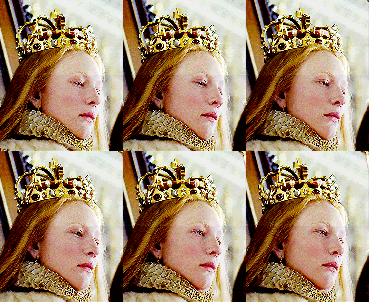

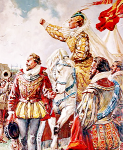

“She is certainly a great Queen and were she only a Catholic she would be our dearly beloved. Just look how well she governs! She is only a woman, only mistress of half an island, and yet she makes herself feared by Spain, by France, by the Empire, by all.”
— Pope Sixtus V describes Queen Elizabeth I, c.1588.
REX: A show chronicling the House of Tudor from Henry VIII’s coronation, to Elizabeth I’s death. (6/?)
*Season 6 starts with Edward VI’s coronation in 1547, and ends with Edward’s death in 1553.
“To a poor woman, for bringing again Cutte the King’s dog, 4s. 8d.”
“For a cow that Uryen Brereton’s greyhounds and lady Anne’s killed, 10s.”
REX: A show chronicling the House of Tudor from Henry VIII’s coronation, to Elizabeth I’s death. (4/?)
*Season 4 starts with the first Act of Supremacy in 1534, and ends with Henry’s marriage to Anne of Cleves in 1540.
 Site Title