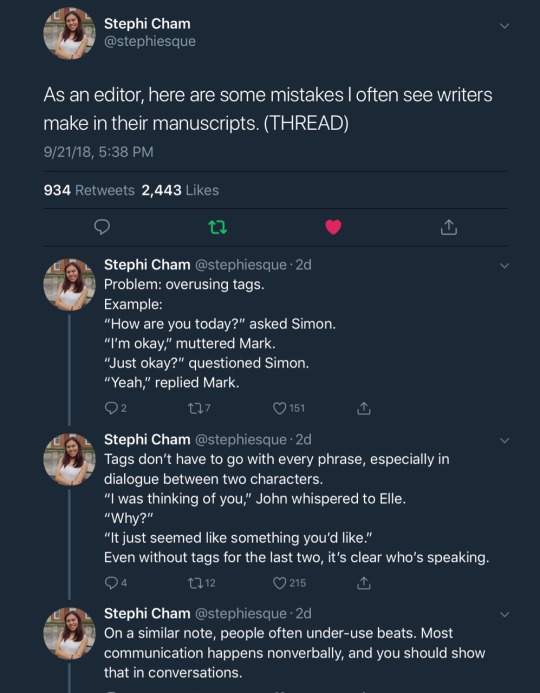
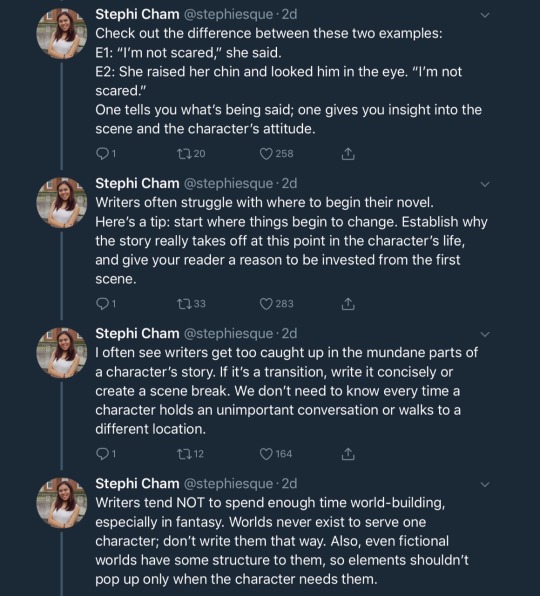
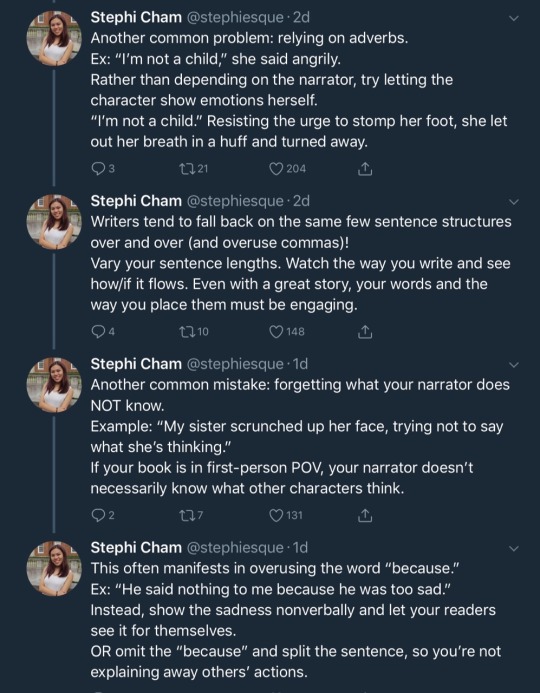
This. This is good fiction writing advice. I really appreciate how it was formatted as “this is a common problem, here is a solution to try in your own work” and not “oh god, don’t do that!” without any extra help. And I extra appreciated the “don’t rely on adverbs” bit, because they do have their place but they aren’t the only way actions can be emphasized.
You keep writing anyway. Inspiration is real, and it matters, but it’s not going to be there every day. And the work still needs to be done.
Here, I will quote myself:
If you only write when you’re inspired you may be a fairly decent poet, but you’ll never be a novelist because you’re going to have to make your word count today and those words aren’t going to wait for you whether you’re inspired or not.
You have to write when you’re not inspired. And you have to write the scenes that don’t inspire you. And the weird thing is that six months later, a year later, you’ll look back at them and you can’t remember which scenes you wrote when you were inspired and which scenes you just wrote because they had to be written next.
I know. I found a pile of papers of mine from my teen years and into my early twenties recently, and there were so many stories begun, so many first pages of novels never written. I’d start them, and then I’d give up because they weren’t as brilliant as Ursula K Le Guin, or Roger Zelazny, or Samuel R Delany, and anyway I wasn’t actually sure what happened next.
I was around 22 when I started finishing things. They weren’t actually very good, and they all sounded like other people, but the finishing was the important bit. I kept going. A dozen stories and a book, and then I sold one (it wasn’t very good, and I had to cut it from 8,000 words to 4,000 to sell it, but I sold it). I probably wrote another half-dozen stories over the next year, and sold three. But now they were starting to sound like me.
Think of it this way: if you wanted to become a juggler, or a painter, you wouldn’t start jugggling, drop something and give up because you couldn’t juggle broken bottles like Penn Jillette, or start a few paintings then give up because the thing in your head was better than what your hands were getting onto the paper. You carry on. You learn. You drop things. You learn about form and shape and shade and colour and how to draw hands without the fingers looking like noodles. You finish things, learn from what you got right and what you got wrong, and then you do the next thing.
And one day you realise you got good. It takes as long as it takes. So keep writing. And all you need to do right now is try to finish things.
there’s going to be a difference sometimes between the stories that you find masterfully crafted and the stories that mean a lot to you personally and those two things don’t have to overlap completely or even at all to make that story worthwhile
and that’s a good thing to remember as a reader/viewer/etc but also as a writer because even if whatever you ultimately write is full of mistakes, someone out there is gonna take it so to heart that it fundamentally changes them as a person. and that is. Huge.
Like! I made a list of the top ten stories that have influenced me as a human being and only 2 or maybe 3 of them are things I would hold up as examples of narrative mastery. But I cannot imagine who I would be without the other 7!!
Please write your story and share it with the world! Someday someone will not be able to imagine a world without your story in it and they’ll be so grateful you brought that wonderful, meaningful thing into their life
Also while I’m on a roll, a story doesn’t have to have some deep hidden meaning or philosophical theme for it to be meaningful. Sometimes a story is meaningful to someone because it was fun and made them happy at a time when they really, really needed that. Or because it was an incredibly intriguing world that inspired them to dream. Maybe they’re another writer, and they see in that thing you wrote the exact kind of story they want to tell someday.
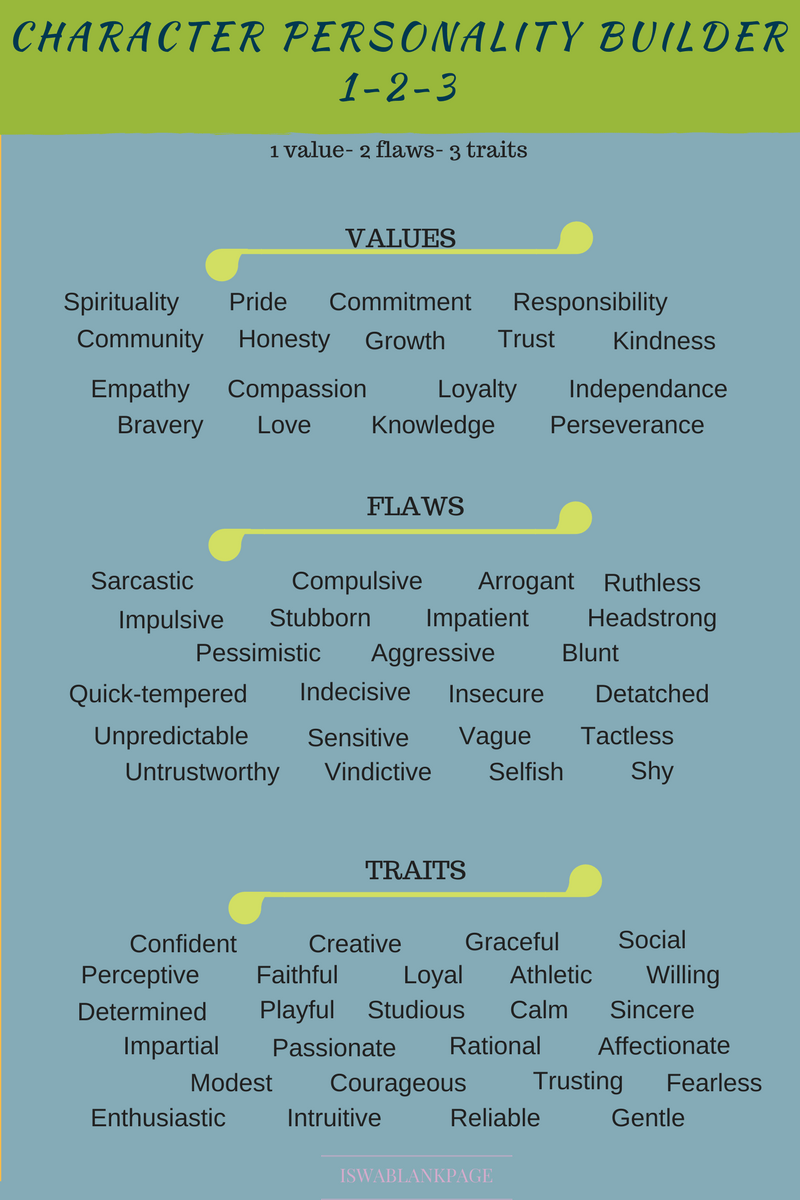
I made this today as I find it’s a helpful tool when I make characters. I call it the 1-2-3 method.
1 value: Their core belief.
2 flaws: The limitations of the character. Things that can affect their actions and abilities.
3 traits: What makes them, them. the aspects of their behaviour and attitude.
It’s important that you justify their personality through their backstory and home life, however, and it’s good to have conflicting flaws/traits within a group which will help create tension and drama.
I’m using this today to create characters for my campnanowrimo WIP and thought I’d share.
I’m beginning to really understand beauty and how I unconsciously praise it in others and the more that I think about it, the more I’m angered by it. I’m thankful for reading and writing because it makes things really small and you have to pay attention to the world when you are a writer. No wonder every writer under the sun is immensely exhausted lol, It reminds me of what Susan Sontag said:
And I also think about what Joan Didion said in The Center Will Not Hold about how when she analyzed something, she was no longer afraid of it. I know that people generally say that you shouldn’t overthink or look too deeply into things but I feel writers have to fall right into those things in order to feel OK and feel some sort of clarity.
I am a True Believer in outlining before you write. (At least, so long as an outline doesn’t debilitate your writing.)
But I think some people don’t understand what that means to me.
To me, an outline means that I know:
Where the story is going.
What beats it’ll take getting there.
The major content I know I want to write.
How that content can be reasonably connected.
Where character development decisions should take place.
What the climax will entail.
What choices the characters will be forced to make during the climax to fulfill or deny their developmental arc.
It also means that along the way I might…
Randomly move multiple scenes to a completely new settings.
Rearrange scenes to make for better pacing.
Throw in conversations I never imagined the characters would have.
Completely change one of my main character’s voices in the third chapter.
Have a random side character mysteriously foreshadow grudges certain characters are holding.
Realize certain characters have legitimately been holding said grudges.
Add in new character arcs for said characters to get them to work through their grudges.
Watch as the main ship progresses way faster than intended.
(Cry over the main ship.)
Let the protagonist chose to go by an alias because he’s more insecure than I thought.
Watch as his brother ruins his alias attempts four chapters later.
Create an entire new arc that revolves primarily around the protagonist wanting to sleep in a proper bed after camping for three weeks. (And do a lot of last minute plot adjusting to make the pacing still work for this bed-related arc.)
Forget one of my main characters exists for five chapters.
Suddenly add her into an arc she wasn’t supposed to be in, to make up for it.
Be bamboozled as the love interest refuses to sit still long enough to let their leg heal and ends up with a permanent injury.
Flat out re-outline entire chapters because the new idea worked better with the character development or pacing.
Realize that the symbolism I had for a certain thing has actually meant something different all along.
Add in a motto I didn’t realize was a huge part of two of the main character’s lives in the previous book.
Take about ten thousand notes on what needs to be adjusted in the next draft.
Cry because I think the novel will be too long.
Cry because I think the novel will be too short.
Cry because I love it too much.
Cry because it’s definitely the worst thing ever written.
So, when I say I’m a True Believer in outlining, I don’t mean that I’m a believer in never letting your story’s surprise you, or never making last minutes adjustments, or never throwing out huge parts of your outline for something better.
I mean that I’m a true believer in letting your story have a foundation before you write it, because any large or complex story built on a weak foundation, like a castle built in the sand, will need to be re-built later.
But the stronger a foundation you build for it, the easier it is to make changes without your entire structure falling apart.
#This is not saying that some writers don’t do better just rebuilding the castle later or that all stories are complex enough to warrant outlines. #Please do not take my post about what outlining means to me and attempt to writer’splain to me how some writers can’t use outlines. #I literally put that disclaimer right below the title. #Read and think before you reply.
When your writing doesn’t feel original or worthwhile.
Aw, thank you, nonny ❤
To be entirely honest with you, if it’s something you tend to struggle with, then there’s probably no way to remove the feeling entirely. Many authors,even bestselling authors with dozens of published books, feel like this on a regular basis. Just keep reminding yourself that:
Your ideas won’t seem as mysterious or intriguing as anyone else’s because they’re yours – but there are other writers out there looking at your ideas you deem unoriginal and wishing they could be as creative as you are.
All ideas have been done before, and it’s how well you do them that counts far more than what they actually are.
You chose your story for a reason. What did you love about it before you started looking at the grass on the other side of the fence?
The longer you work on the same idea, the less creative it often feels to you. Something which seemed unique last month feels mediocre after two months and a year later it’s the worst idea ever. But that’s okay, because no one else but you (and maybe your editor or agent) is going to spend months or years submerged in the violent battle of making this story actually work, so no one else is going to get bored of it.
To slightly paraphrase one of my (many) favorite @neil-gaiman quotes:
The last novel I wrote, when I got three-quarters of the way through I called my agent. I told her how stupid I felt writing something no-one would ever want to read, how thin the characters were, how pointless the plot. I strongly suggested that I was ready to abandon this book.
She simply said, suspiciously cheerfully, “Oh, you’re at that part of the book, are you?”
I was shocked. “You mean I’ve done this before?”
“You don’t remember?”
“Not really.”
“Oh yes,” she said. “You do this every time you write a novel. But so do all my other clients.”
We all feel like our writing isn’t good enough.
(Just today in fact, I had a miniature meltdown because I decided all my characters from The Warlord Contracts were just carbon copies of a cardboard cut out. I know a large part of the chaos in all three books is caused by the fact that the main characters are so incredibly different that they can’t agree on anything, ever, and the scene I was writing had an entire paragraph of Vasha trying to convince himself that Mantas isn’t a bad leader just because her ideas are often in direct opposition to his own, and yet some dark insecure goblin in my brain manages to win its foundless argument anyways.)
We, and our brain goblins, may not always feel just our ideas or writing are great or even good, but I promise this is a natural feeling for writers — one which will only bleed into your stories if you let it taunt you into ending them.




 Site Title